EcoRain Underground stormwater systems are a great way to integrate stormwater systems underground and into your site's parking area and landscape areas.
Wednesday, November 10, 2010


Thursday, November 4, 2010
Storm Drain Filter Made From Groundcloth - Innovations On-Site
The photo below was taken along a road in Jacksonville, Florida where the contractor had installed a new water supply line.
During construction the existing sidewalk and asphalt road edge were excavated, along with dirt from the water supply line trench.
After the new supply line was installed, the dirt, rock and debris covered the surface.
Normally a contractor would plant rye-grass, clover or some other fast-growing cover crop to prevent erosion and stabilize the ground.
Apparently the surface stabilization did not occur as vegetation was not present. However it may have been unsuccessfully attempted as the area is in the middle of a five week drought and with zero irrigation available the seeds may not have sprouted. Sod was not installed.
The area is important as it lies adjacent the St. Johns River. Any discharge of silt and trash to the storm sewer would be a direct discharge to either a tributary to or the St. John's River itself.
The contractor deserves credit though for an innovative approach to erosion prevention.
Granted the drain appears to be on the verge of becoming overwhelmed with siltation and gravel, but as I looked into the cover, the fabric - the ground cover was a heavier weight allowing for water to run through while preventing trash from entering the sewer system - the fabric was still intact.
There are obvious disadvantages to this system.
However first of all, the fabric is doing what it was intended to do - keep debris and silt out of the stormwater system.
Yet it may be overwhelmed with the volume of silt.
How strong is the fabric and how long will it last?
If the fabric is strong enough to hold up during a heavy rain, will it clog and back up, causing a potential safety hazard with ponding in the road?
Is the fabric a better and safer approach than say an Erosion Eel or other type of barrier?
We will keep photos posted as rain events occur.
Your comments and thoughts are welcome.
Kevin
During construction the existing sidewalk and asphalt road edge were excavated, along with dirt from the water supply line trench.
After the new supply line was installed, the dirt, rock and debris covered the surface.
Normally a contractor would plant rye-grass, clover or some other fast-growing cover crop to prevent erosion and stabilize the ground.
Apparently the surface stabilization did not occur as vegetation was not present. However it may have been unsuccessfully attempted as the area is in the middle of a five week drought and with zero irrigation available the seeds may not have sprouted. Sod was not installed.
The area is important as it lies adjacent the St. Johns River. Any discharge of silt and trash to the storm sewer would be a direct discharge to either a tributary to or the St. John's River itself.
The contractor deserves credit though for an innovative approach to erosion prevention.
 |
| Protecting Stormwater Drains from Pollution |
There are obvious disadvantages to this system.
However first of all, the fabric is doing what it was intended to do - keep debris and silt out of the stormwater system.
Yet it may be overwhelmed with the volume of silt.
How strong is the fabric and how long will it last?
If the fabric is strong enough to hold up during a heavy rain, will it clog and back up, causing a potential safety hazard with ponding in the road?
Is the fabric a better and safer approach than say an Erosion Eel or other type of barrier?
We will keep photos posted as rain events occur.
Your comments and thoughts are welcome.
Kevin
Thursday, October 21, 2010
Floating Wetlands Offer Many Benefits - Efficiency Testing at UF
Floating wetlands have been discussed here before. They clean stormwater, provide significant wildlife habitat and create beauty.
The photo below was taken Wednesday, October 20th and is of a test platform in Gainesville, Florida where the University of Florida is conducting tests on the system.
The white barrier around the Floating Wetland isolates the water column and allows for analysis of the water immediately adjacent the system and system roots.
For more information on floating wetland systems, contact us today.
The photo below was taken Wednesday, October 20th and is of a test platform in Gainesville, Florida where the University of Florida is conducting tests on the system.
The white barrier around the Floating Wetland isolates the water column and allows for analysis of the water immediately adjacent the system and system roots.
For more information on floating wetland systems, contact us today.
 |
| Floating Wetland - Testing for Water Quality |

Wetland and BioSwale Creation in Floodplain Areas
Floodplain compensation based on storage volume typically must be the same for pre-development and post development conditions here in Florida. That is unless your site is adjacent a tidal area.
Many times these 'dug holes' are simply dry, ugly holes in the ground.
However, by excavating the floodplain compensation area down a little deeper the end result can produce a beautiful, functioning wetland or BioSwale with immense benefit.
Since floodplain compensation credit is given for volumes created above seasonal high groundwater elevations, over excavation by a couple additional feet ( one meter or so) can produce hydrology necessary for the functioning system.
The BioSwale pictured in the photo is located in central Florida. It is created in a floodplain compensation area and is approximately two years old.
The beauty of this system is its capacity to clean water with plants and the habitat provided for endemic wildlife.
Yesterday we were reviewing success progress of plant establishment on the site and witnesses Sandhill cranes, deer, raccoons, alligators, fish, snipes, kestrels and other species using the created BioSwale. Moreover, many of the aquatic plants were flowering.
Next time you design a project with floodplain compensation, consider over-excavating a little and creating a BioSwale. Feel free to email us with questions. Kevin.
Many times these 'dug holes' are simply dry, ugly holes in the ground.
However, by excavating the floodplain compensation area down a little deeper the end result can produce a beautiful, functioning wetland or BioSwale with immense benefit.
Since floodplain compensation credit is given for volumes created above seasonal high groundwater elevations, over excavation by a couple additional feet ( one meter or so) can produce hydrology necessary for the functioning system.
The BioSwale pictured in the photo is located in central Florida. It is created in a floodplain compensation area and is approximately two years old.
The beauty of this system is its capacity to clean water with plants and the habitat provided for endemic wildlife.
Yesterday we were reviewing success progress of plant establishment on the site and witnesses Sandhill cranes, deer, raccoons, alligators, fish, snipes, kestrels and other species using the created BioSwale. Moreover, many of the aquatic plants were flowering.
Next time you design a project with floodplain compensation, consider over-excavating a little and creating a BioSwale. Feel free to email us with questions. Kevin.
 |
| BioSwale - Sustainable Stormwater |

Tuesday, October 19, 2010
Stormwater Strategy - Native Plants for BioSwales
Native plants suitable for stormwater plantings, bioswales and modular wetlands will be the topic of our next several posts.
Importantly, native species should be the choice for landscaping bioswales nad areas adjacent to and surrounding stormwater facilities.
Native plant species possess the inherent ability to 'Acclimate' to most sub-ecotones on a site. Moreover, native plant species typically require only enough temporary irrigation to allow themselves to become established. This is important since we live in a time where water supply and reserves have reached critical levels.
Purple muhly grass is shown below. Also know by the scientific name, Muhlenbergia capillaris, purple muhly grass benefits a site in many different ways, including;
1. acts as a filter preventing trash from entering the water's edge,
2. uptakes pollutants such as nitrogen, phosphorous and carbon,
3. produces oxygen,
4. provides significant foraging and communal habitat for wildlife, and
5. creates beauty.
Purple muhly grass can tolerate periodic inundation, high groundwater tables and also is very resiliant to drought.
Though many consider native plants - 'weeds' - a sharp landscape designer can take native flowering species and accomplish much.
Consider using native species for your next bioswale project, especially Muhlenbergia capillaris - purple muhly grass.
Please feel free to email us with your gren and sustainable bmp questions.
Kevin
Importantly, native species should be the choice for landscaping bioswales nad areas adjacent to and surrounding stormwater facilities.
Native plant species possess the inherent ability to 'Acclimate' to most sub-ecotones on a site. Moreover, native plant species typically require only enough temporary irrigation to allow themselves to become established. This is important since we live in a time where water supply and reserves have reached critical levels.
Purple muhly grass is shown below. Also know by the scientific name, Muhlenbergia capillaris, purple muhly grass benefits a site in many different ways, including;
1. acts as a filter preventing trash from entering the water's edge,
2. uptakes pollutants such as nitrogen, phosphorous and carbon,
3. produces oxygen,
4. provides significant foraging and communal habitat for wildlife, and
5. creates beauty.
 |
| Purple muhly grass, native stormwater area-bioswale plant |

Though many consider native plants - 'weeds' - a sharp landscape designer can take native flowering species and accomplish much.
Consider using native species for your next bioswale project, especially Muhlenbergia capillaris - purple muhly grass.
Please feel free to email us with your gren and sustainable bmp questions.
Kevin
Sunday, October 10, 2010
Sustainable Gabions for Stormwater - Mining Rock Obsolete
Gabions have always been popular as an erosion control BMP or as a more eco-friendly and low impact development for stemwalls or retaining walls.
Oyster shell filled gabions can eliminate harmful mining of rock and offer a sustainable alternative to stone filled baskets.
Oyster shells can be purchased along the Gulf Coast, or ordered from your local stone company.
Perfect for LEED Certified projects, be sure to specify oyster shell gabions on your next project.
Oyster shell filled gabions can eliminate harmful mining of rock and offer a sustainable alternative to stone filled baskets.
Oyster shells can be purchased along the Gulf Coast, or ordered from your local stone company.
Perfect for LEED Certified projects, be sure to specify oyster shell gabions on your next project.
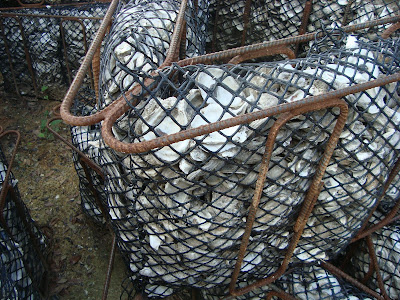 |
| Oyster Shell Gabions - Sustainable BMPs |

Saturday, October 9, 2010
Bio-Retention Treatment Train Serves as Low Imapct Development Stormwater System, Cleaning Runoff and Providing Habitat for University of North Florida
The low impact designed bio-retention stormwater treatment system shown in the below photos successfully cleans stormwater, provides wildlife with habitat and forage, and is an attractive landscape feature.
Stormwater runoff from the University of North Florida parking lot drains into the swale vegetated with native herbaceous groundcovers including Frog Fruit (Phyla or Lippia), Dollarweed (Hydrocotyle) and other species.
The runoff filters into the soils and the surrounding plant roots act biologically to remove nitrogen, phosphorous and other pollutants.
During hard storms, the excess stormwater runoff overflows into a larger, wet-meadow type system. In this system plants and trees such as Cypress, Wax Myrtle, Muhly Grass and Andropogon conduct the same nutrient uptake and evapo-transpiration processes yet on a larger scale.
Ultimately, the bio-retention system replaces open-water, mosquito breeding ponds. The UNF system efficiently accomplishes stormwater cleansing, provides wildlife with communal habitat and foraging stock, and creates a pallet of native beauty.
Hopefully, site designers will utilize the proven and effective bio-retention technology for site development in the future.
Stormwater runoff from the University of North Florida parking lot drains into the swale vegetated with native herbaceous groundcovers including Frog Fruit (Phyla or Lippia), Dollarweed (Hydrocotyle) and other species.
The runoff filters into the soils and the surrounding plant roots act biologically to remove nitrogen, phosphorous and other pollutants.
During hard storms, the excess stormwater runoff overflows into a larger, wet-meadow type system. In this system plants and trees such as Cypress, Wax Myrtle, Muhly Grass and Andropogon conduct the same nutrient uptake and evapo-transpiration processes yet on a larger scale.
Ultimately, the bio-retention system replaces open-water, mosquito breeding ponds. The UNF system efficiently accomplishes stormwater cleansing, provides wildlife with communal habitat and foraging stock, and creates a pallet of native beauty.
Hopefully, site designers will utilize the proven and effective bio-retention technology for site development in the future.
 | |
| Bio-retention Swale for Low Impact Development, UNF |

 |
| Bio-Retention Meadow or Wet-Prairie Type SWMF, UNF |

Subscribe to:
Posts (Atom)